Linen Season: How One Fabric Became Summer's Answer
When Summer Arrives, So Does Linen
Every summer, the wardrobe remembers linen. With its natural creases, coarse texture, and a hint of ease, it is almost the default language of the season. Yet this seemingly casual fabric holds one of humankind's oldest textile histories.
A Cloth That Spans Tens of Thousands of Years
Linen is woven from the bast fibers of the flax plant. In a cave in Georgia (the South Caucasus), archaeologists found dyed wild flax fibers dating back around 30,000 years — considered some of the earliest evidence of humans using linen-like fabrics.
In ancient Egypt, white linen was both everyday clothing and the material for mummy wrappings and priests' garments, regarded as a symbol of purity and light. The Tarkhan dress, considered among the oldest woven garments in the world, is made of linen.
Why It Is Born for Summer
Linen's coolness is no illusion; it has a physical basis:
- High thermal conductivity: linen feels cool to the touch precisely because it conducts heat well, carrying warmth away from the skin.
- Strong and absorbent: flax fibers are very strong, highly absorbent, and dry faster than cotton, which makes wearing it more comfortable in the heat.
- Softer with every wash: linen doesn't pill or shed, and grows softer the more it is washed.
As for its signature creases — those come from flax's poor elasticity and tendency to wrinkle. Once dismissed as a mark of "low quality," that wrinkle is now a natural beauty many people love.
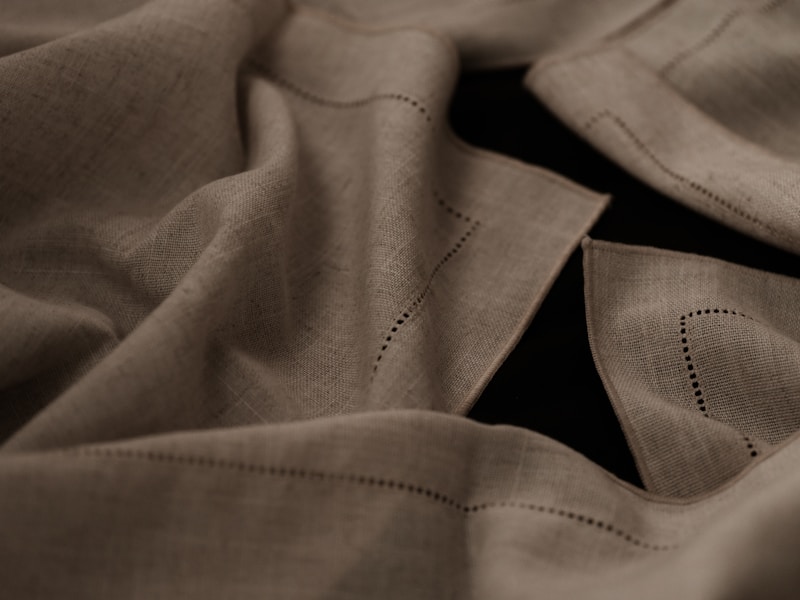
The Slow Craft Behind the Cloth
Linen's preciousness owes much to its laborious making. To get long, soft fibers, the flax is pulled up whole or cut close to the root, dried, then put through a series of steps:
- Retting: bacteria break down the pectin that binds the fibers together.
- Scutching: the woody stalk is crushed and separated away.
- Heckling: combs remove the short fibers, leaving only the long, soft ones.
This is why linen's output is far smaller than cotton's, and its price higher. Today, Belgium and Italy remain important sources of high-quality linen fabric.
How to Make Peace with Its Creases
- Don't fight the wrinkles: linen's crease is a feature, not a failure. Choose cuts designed for a "natural drape."
- Iron when slightly damp: if you want it smooth, ironing while half-dry takes the least effort.
- Better with wear: a good linen grows softer and more comfortable over time — worth raising slowly.
"Linen doesn't chase perfect smoothness; it wears the marks of time and use into its own character." —— Guushu Design Team